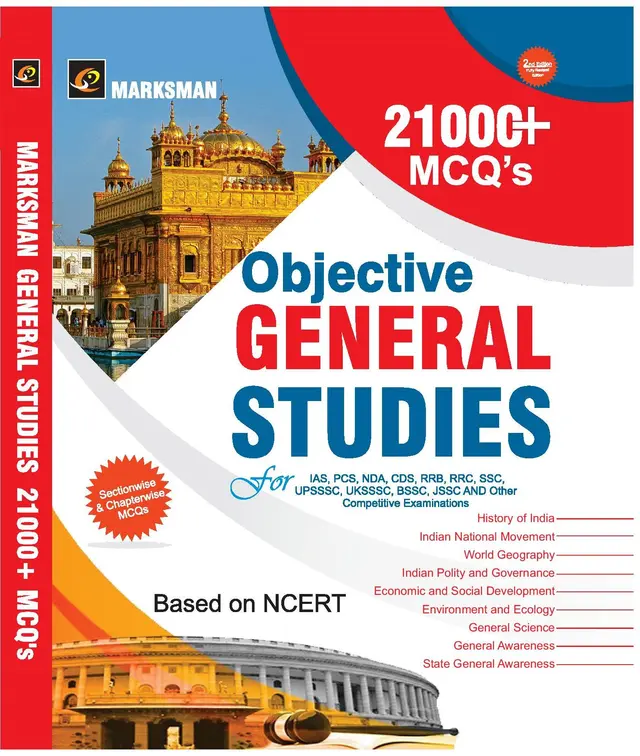
You can use Objective General Studies 21000 MCQ Chapter-wise to build a steady, chapter-by-chapter foundation that aligns with NCERTs and common exam syllabi. This book gives you a huge, organized MCQ bank so you can target weak topics, drill concepts systematically, and track progress with chapter-wise practice.
Expect clear coverage across subjects and chapters so you can focus study sessions on specific gaps instead of guessing what to review. The article will show how to turn this volume of questions into a disciplined plan, select high-value topics, and apply effective practice strategies that improve accuracy and recall.
Comprehensive Chapter-Wise Coverage
This book breaks down thousands of objective questions by specific chapters and topics, matching common competitive-exam patterns. You’ll find concentration on history, geography, polity, science, economy, and current affairs with chapter-level granularity and practice density.
Subject-wise MCQ Distribution
You get clear counts and focus areas for each major subject so you can plan study time. Typical distributions include large banks of questions for:
- History & Culture: ancient to modern periods, artefacts, and personalities.
- Geography: physical, human, and environment-related MCQs.
- Polity & Governance: Constitution, institutions, and recent amendments.
- Economy: basic macro/micro concepts, budgets, and schemes.
- Science & Technology: fundamentals plus applied questions relevant to exams.
Use the list below to prioritize practice:
- High-weight chapters (e.g., Modern Indian History, Physical Geography) — practice daily.
- Medium-weight chapters (e.g., Indian Economy, Polity) — alternate days.
- Low-weight but high-frequency topics (e.g., Environment, Current Affairs snippets) — short, regular drills.
The book’s chapter-wise arrangement makes it easy to target weak topics and track improvement by subject.
Latest Syllabus Alignment
You will find most chapters mapped to common UPSC and State PCS syllabi and framed to reflect recent exam trends. Each chapter mentions the core syllabus points it addresses, helping you confirm coverage against official notifications.
Look for these alignment cues in each chapter:
- Explicit syllabus tags (e.g., “Polity: Fundamental Rights”).
- PYQ-style items indicating past-exam relevance.
- Updates that incorporate recent laws, schemes, or scientific developments.
This alignment reduces guesswork when choosing practice material and ensures you spend time on exam-relevant areas.
Detailed Solutions Approach
Solutions emphasize concept clarity and stepwise reasoning rather than one-line answers. Each MCQ usually includes:
- A concise explanation (2–4 lines) stating the principle.
- Reference to the chapter or NCERT topic where the concept is taught.
- Quick tips or mnemonics when applicable.
You can expect answer notes to include equations, dates, or definitions where needed. Use the solution format to convert mistakes into targeted revision: mark recurring error types and revisit the cited chapter or NCERT section.
Effective Preparation Strategies
Focus on repetitive, timed practice and a clear revision schedule that targets weak chapters. Prioritize accuracy in foundational NCERT-based MCQs, then expand to higher-difficulty questions and full-length timed sets.
Practice and Self-Assessment Techniques
Use chapter-wise drills: complete 30–50 MCQs per chapter, then mark errors and note concepts you missed. After each drill, create a 1-page error log with the question, correct answer, and one-line reason for the mistake.
Rotate question sources: mix NCERT-based items, previous-year PYQs, and higher-difficulty bank/guide MCQs to expose gaps. Aim for at least 3 full passes over each chapter’s question pool before moving on.
Run weekly mixed-topic mock sets of 100–150 MCQs to test retention under pressure. Score each mock, track accuracy by topic, and convert repeated weak topics into focused micro-sessions of 20–30 targeted questions.
Use spaced repetition for factual items: export error-log facts into flashcards and review them on days 1, 3, 7, 14. Maintain a rolling percentage tracker (accuracy, speed) to quantify progress.
Time Management for MCQ Exams
Practice pacing with a split-time plan. For a 150-question test, allocate 90–100 minutes for first pass (36–40 seconds per question) and reserve 20–30 minutes for review and flagged items.
Adopt a three-tier answering strategy: (A) Answer immediately if confident; (B) Flag and return if partially sure; (C) Skip and attempt in review only if you can eliminate options. This reduces time lost on uncertain questions.
Use timed mini-sprints: 15-minute sessions focusing on 25 tough MCQs to build speed on complex reasoning items. After each sprint, spend 5 minutes reviewing mistakes to avoid repeating them in later sprints.
On test day, manage mental energy: start with your strongest sections to build momentum, drink water, and use short 30–60 second microbreaks between long blocks to reset focus.